
Bow Legs & Early Knee Arthritis in Vadodara
Home > Bow Legs & Early Knee Arthritis in Vadodara
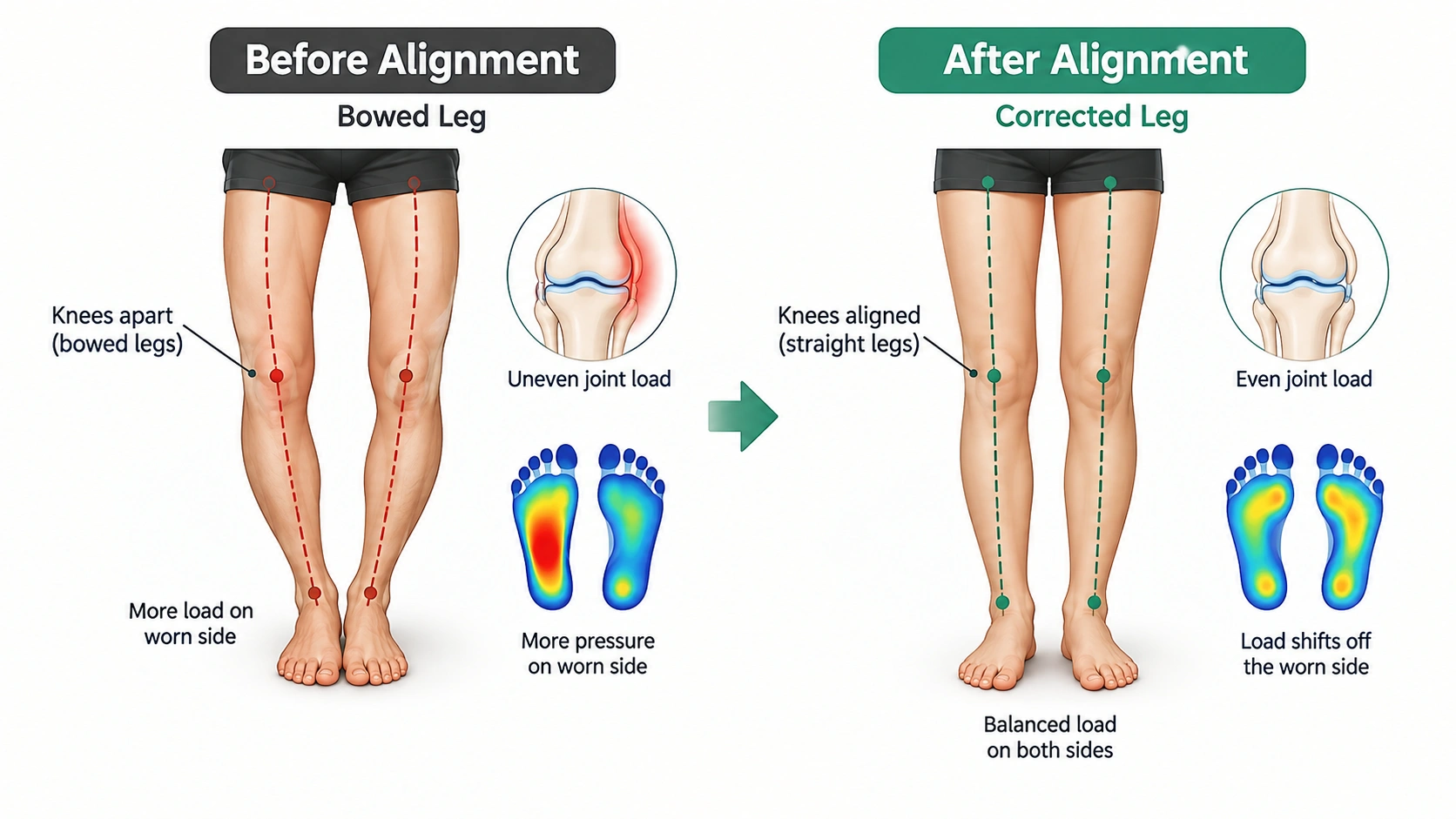
Watch a lot of people with long-standing knee pain and you start to notice something. Their legs curve outward at the knee, the classic bow-legged shape. It is not only about how the legs look. When the legs bow, your weight stops running evenly through the knee and starts grinding down the inner side of it. Give that a few years and the inner half of the joint wears out while the rest of the knee stays perfectly good.
A younger, active person, pain along the inside of the knee, and a visible bow to the leg. We see that combination often, and it has a treatment most patients have never once heard of.
Why Bow Legs Wear Out One Side of The Knee
Which raises an obvious question. If only one side of the knee is worn, why replace the whole thing?
Signs This Might Be You
- Pain mainly along the inner side of the knee
- Legs that curve outward, a bow-legged stance
- You are relatively young and active, and the idea of a full replacement does not sit well with you
- An X-ray showing arthritis in one compartment rather than the whole joint

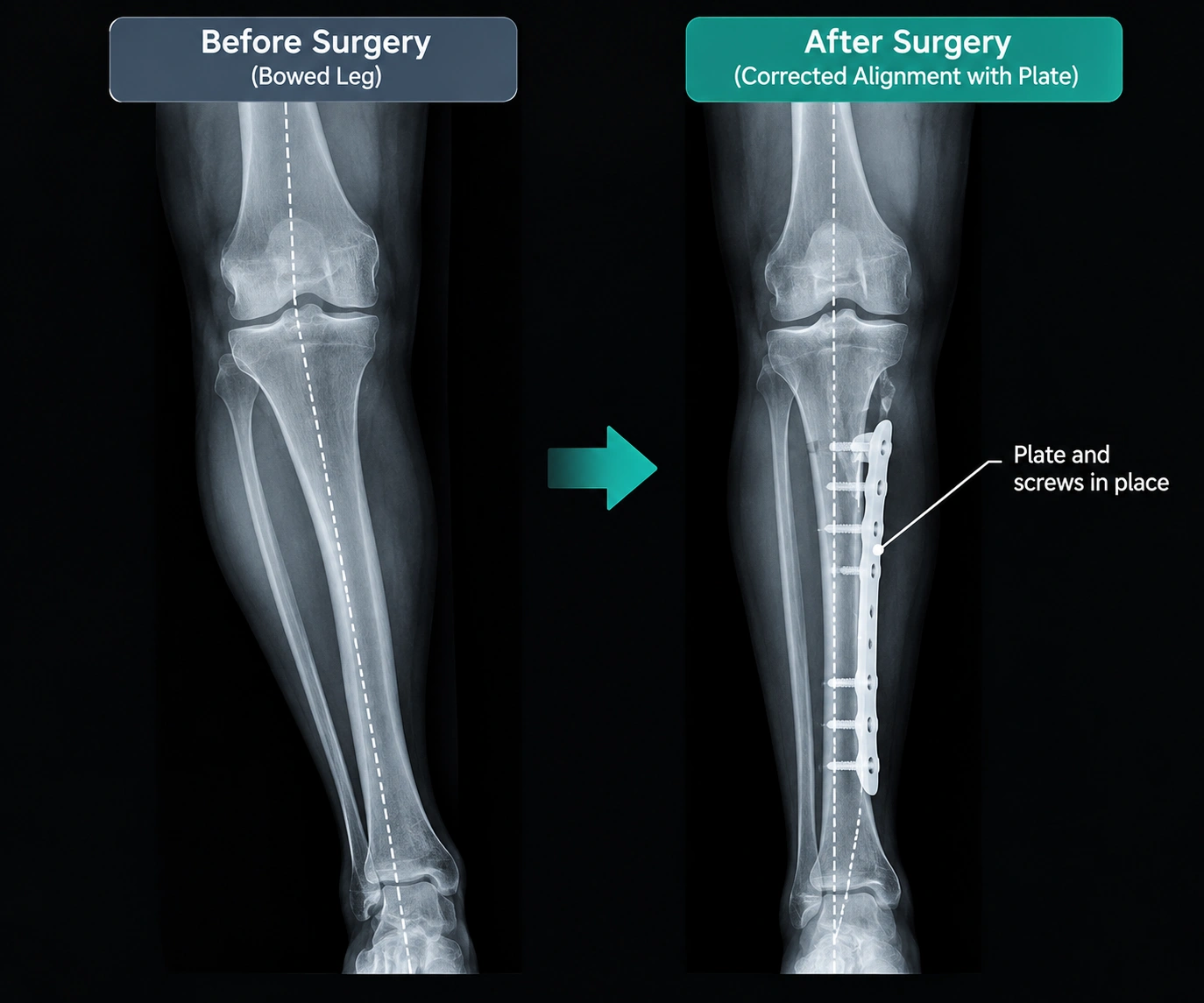
Straightening The Knee Instead of Replacing It: High Tibial Osteotomy
For the right patient this achieves something a replacement simply cannot. You keep a natural, fully bending knee and can stay properly active, sport included, while any future replacement is pushed years down the line, often more than a decade.
Is It Right For You?
HTO suits younger, active patients, commonly in their 40s and 50s, whose arthritis is limited to one compartment and whose bowed alignment is driving it. If arthritis has already spread across the whole knee, or you are older and less active, a partial or total replacement may serve you better. We look at your alignment, your X-rays and how you actually live before pointing you one way or the other.
Since we carry out knee preservation, partial knee replacement (Microplasty) and total knee replacement here, the option we recommend is the one that fits your knee, not the one we happen to prefer doing.
What Recovery Looks Like
An HTO heals much like a carefully controlled fracture. The realigned bone needs time to knit, so recovery is more gradual than a replacement’s, with protected weight-bearing early on and a physiotherapy programme that builds you back to full activity over the following months. Dr. Kunal Shah will set out the timeline for your particular correction.
Frequently Asked Questions
I've been told I'm too young for a knee replacement. What now?
This is the exact situation HTO was designed for. If your arthritis sits on one side and your legs are bowed, realigning the knee can take away the pain and let you keep your own joint, so a replacement can wait until much later in life.
Will straightening my leg really take the pain away?
For well-chosen patients, moving the load off the worn side lifts the pressure off the very spot that hurts. It deals with the mechanical cause rather than papering over it.
Can I play sport after an HTO?
Usually yes, once you have healed, which is one of the main reasons active people pick it over a replacement. Your surgeon will guide what you return to, and when.
How long before I might need a replacement anyway?
For the right patient, many active years, often past a decade, before a replacement is even discussed. And when that time does come, the operation can still be done.
Is it a major operation?
It is planned, precise bone surgery with a proper recovery behind it, more to bounce back from than a keyhole procedure, but with the sizeable reward of keeping your own knee. We will take you through exactly what it involves before you decide anything.